The ATLAS Zero Degree Calorimeter and High-Luminosity Zero Degree Calorimeter
The ATLAS Zero Degree Calorimeter (Run 1-3)#
The ATLAS Zero Degree Calorimeter (ZDC) is the most forward detector of the ATLAS experiment at the CERN Large Hadron Collider. Located approximately 140 m from the interaction point inside the Target Absorber for Neutrals (TAN), it is designed to detect neutral particles emitted at pseudorapidities beyond |η| > 8.3. The ZDC plays a unique role in the ATLAS heavy-ion program by measuring forward spectator neutrons produced in nuclear collisions. These measurements provide essential information on collision geometry and centrality, while also enabling the identification and study of ultra-peripheral collisions (UPCs), in which nuclei interact through their electromagnetic fields rather than via direct hadronic interactions.
Originally installed for the first LHC heavy-ion run in 2010, the ATLAS ZDC has operated throughout Runs 1, 2, and 3 during all heavy-ion data-taking campaigns, including A+A and p+A collisions, as well as dedicated low-μ pp runs used for heavy-ion reference measurements. The detector has also participated in dedicated forward-physics runs in conjunction with the LHCf experiment, providing efficient identification of forward neutrons relevant for cosmic-ray studies.
Since the beginning of LHC heavy-ion operations, the ZDC has been an essential component of the ATLAS heavy-ion program. In hadronic nuclear collisions, it measures spectator neutrons—nucleons that do not participate in the interaction—which provide a direct probe of the collision geometry. In ultra-peripheral collisions, the ZDC is used to tag electromagnetic interactions through the pattern of forward neutron emission, enabling measurements of photon-induced processes. The detector also contributes to heavy-ion luminosity determination and supports dedicated studies of forward neutron production.
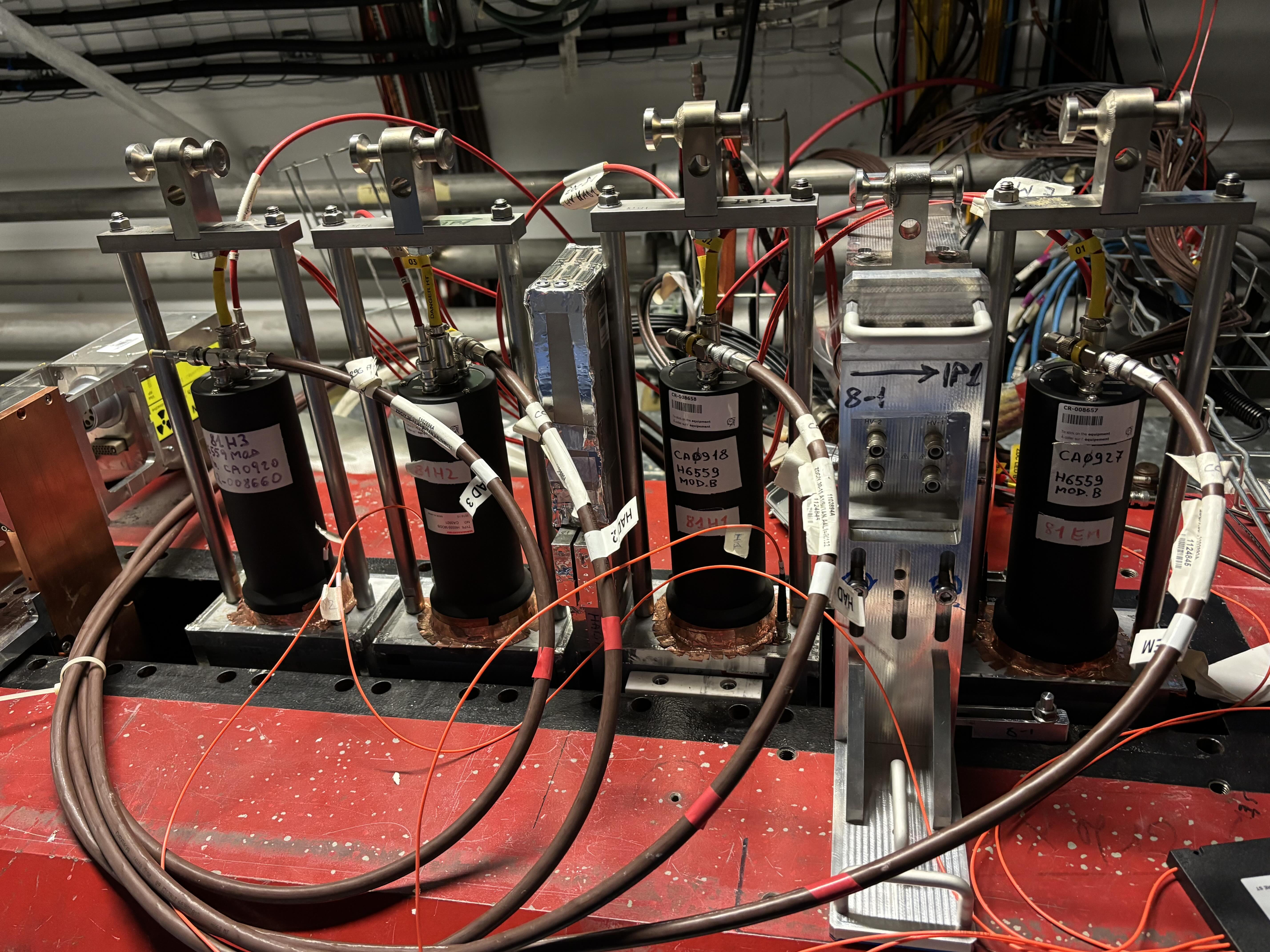
Ahead of Run 3, the detector underwent a major upgrade to significantly enhance its performance. The upgrade included new radiation-hard fused-silica Cherenkov radiators, improved optical coupling and faster signal transmission, fully digital readout electronics, an integrated LED calibration system, and the installation of the new Reaction Plane Detector (RPD). The RPD provides fine transverse segmentation of the forward energy deposition, enabling event-plane measurements and improving the detector’s capability to characterize the geometry of heavy-ion collisions. Together, these upgrades substantially enhanced the detector’s precision, timing performance, and operational reliability for the Run 3 heavy-ion physics program.
The ATLAS High-Luminosity Zero Degree Calorimeter Project (Run 4++)#
The High-Luminosity Zero Degree Calorimeter (HL-ZDC) is the next generation of forward calorimetry for the heavy-ion program at the High-Luminosity LHC, starting with Run 4. Building on the experience of the existing ZDC, the project will preserve and extend the measurement of forward spectator neutrons, supporting the characterization of nuclear collisions and the identification of ultra-peripheral collisions (UPCs). These capabilities are essential to making full use of the heavy-ion physics opportunities of the HL-LHC.
The detector is being developed through a collaboration between the ATLAS and CMS ZDC efforts, bringing together expertise in calorimetry, detector instrumentation, and heavy-ion physics. The development program combines pre-production detector construction with dedicated beam tests to characterize the calorimeter response and guide the next stages of the upgrade.
Dr. Riccardo Longo serves as the ATLAS HL-ZDC upgrade project leader, and our ATLAS Torino group is deeply involved in the project. Our group contributes directly to the experimental work at CERN, with a strong presence in test-beam preparation, beam instrumentation, detector operation, and data taking. Graduate and undergraduate students work alongside experienced researchers, gaining hands-on experience in the development and validation of a new detector for the HL-LHC.
In 2026, the project completed two complementary test-beam campaigns in CERN’s H4 beam line. The July campaign—First light for the HL-ZDC exposed the pre-production detector to electron, proton, and muon beams for the first time, collecting the data needed to characterize its response under controlled conditions. The Pb-ion campaign of 12–19 August then studied its response to neutral fragments, especially neutrons, produced by the fragmentation of a lead-ion beam. Together, these datasets provide complementary measurements to assess the pre-production calorimeter and guide its further development toward operation at the HL-LHC.