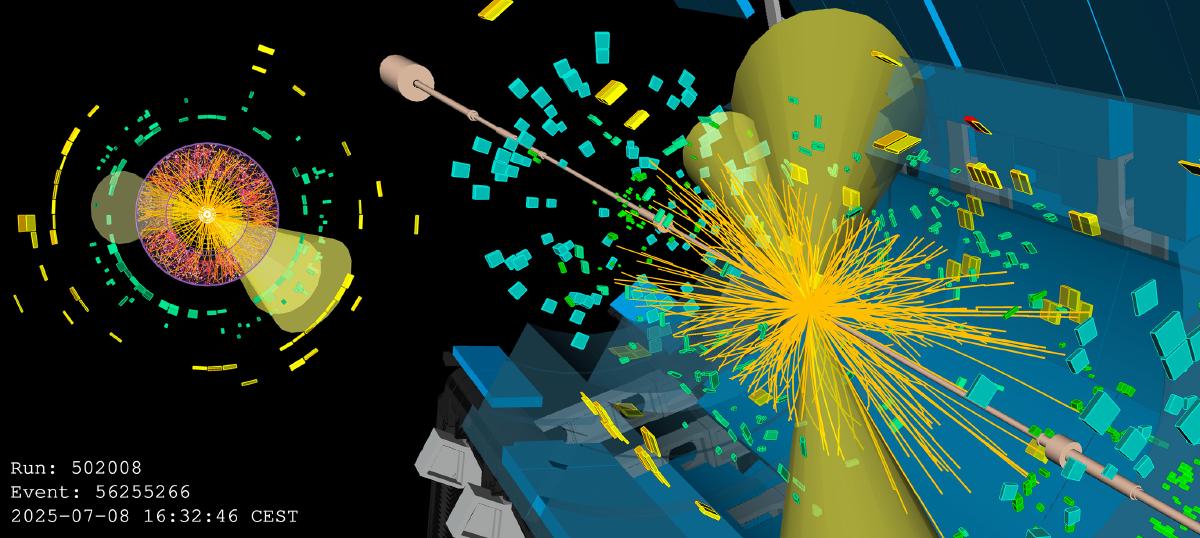
CERN has highlighted new results from the four main LHC experiments showing indications that oxygen–oxygen and neon–neon collisions can produce quark–gluon plasma (QGP), the extreme state of matter that filled the Universe shortly after the Big Bang.
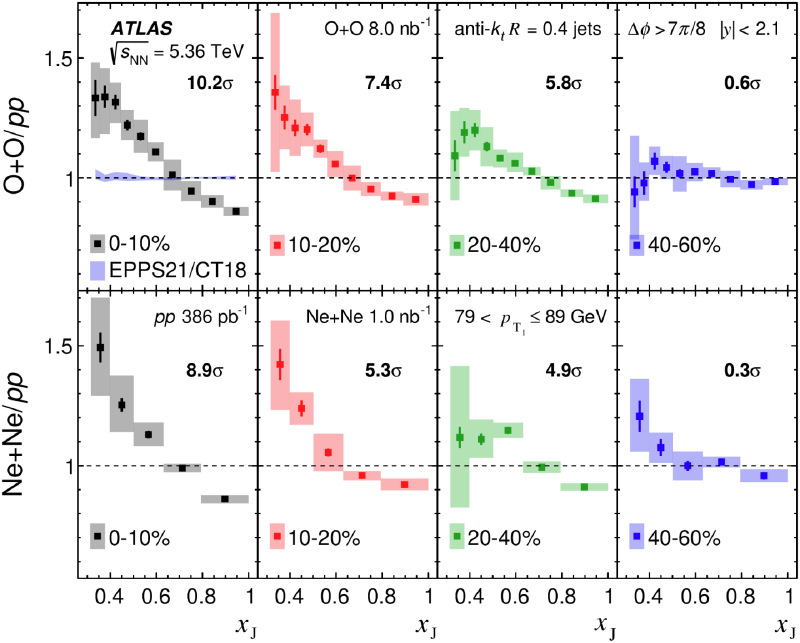
Among these results, the ATLAS Collaboration reports the first observation of parton energy loss in oxygen–oxygen and neon–neon collisions at the LHC. The effect was observed through the momentum imbalance of pairs of particle jets and becomes stronger in more central collisions, as expected when the jets traverse a larger volume of QGP (see the Figure below)
This result was achieved through major contributions from our group, with INFN graduate student Matthew Hoppesch leading the analysis alongside Dr. Riccardo Longo. The study of non-quenching baseline for the dijet asymmetry were subject of the bachelor’s thesis of undergraduate student Enrico Peter Grande. The work was conducted in close collaboration with Dr. Longo’s former group at the University of Illinois Urbana-Champaign, led by Prof. Anne Marie Sickles and including graduate student Yi Liu, who remains under Dr. Longo’s supervision, as well as with Dr. Martin Rybar of Charles University in Prague.
The article, submitted to Phys.Rev.Lett., can be found on arXiv:2606.20463 and is the first result led by the Torino group after its constitution in June 2025. We are looking forward to the next ones!
Read the full CERN news article.
The results were also the subject of a dedicated ATLAS Physics Briefing