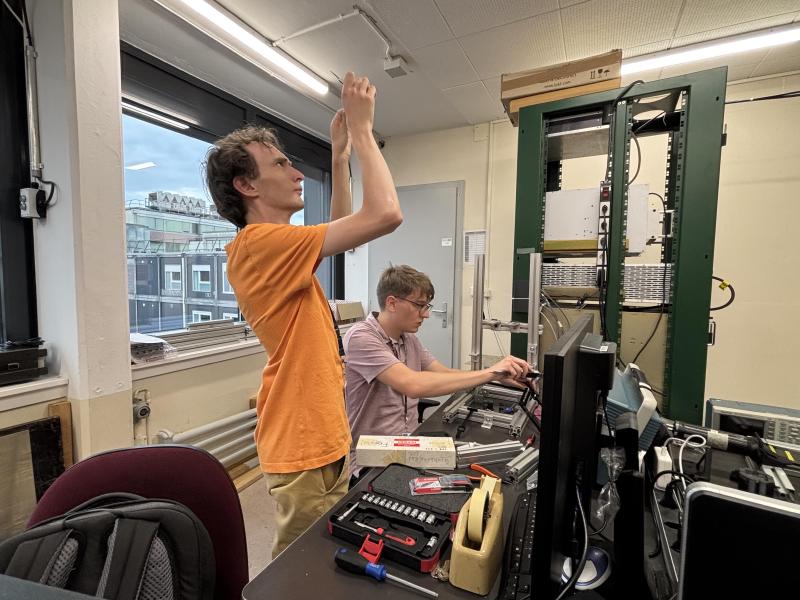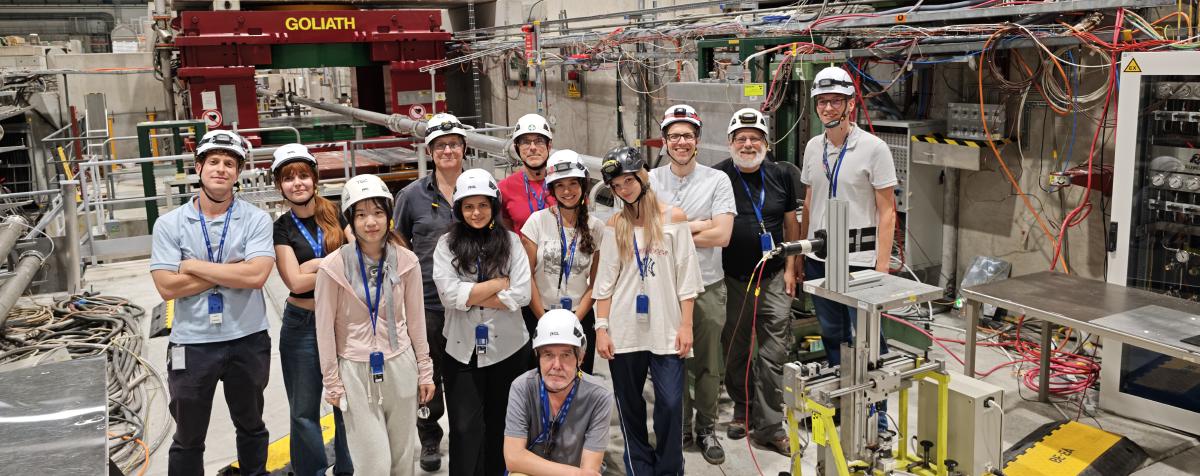

From 12 to 19 August 2026, the joint ATLAS and CMS High-Luminosity Zero Degree Calorimeter (HL-ZDC) team carried out a successful Pb-ion test-beam campaign in CERN’s H4 beam line. The campaign followed the hadron test beam performed in July and provided the complementary ion data needed for a comprehensive evaluation of the HL-ZDC pre-production detector.
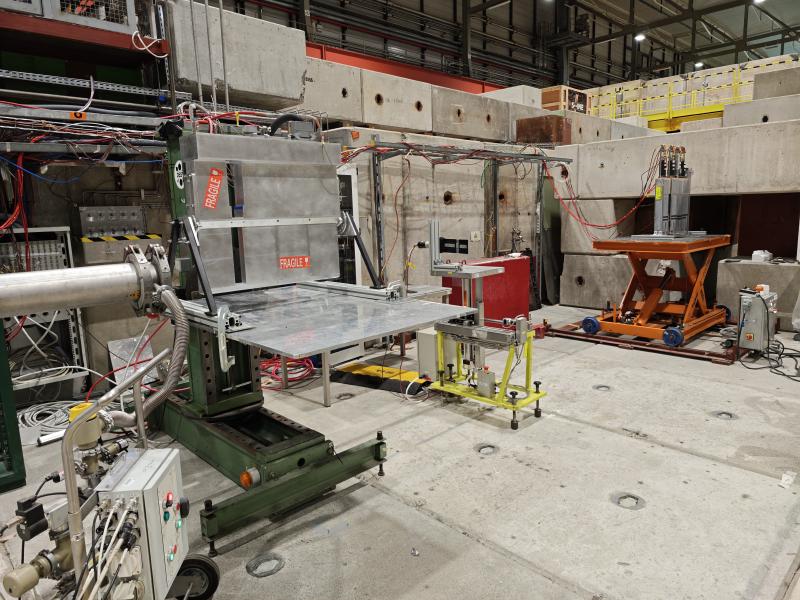
The test allowed to study the HL-ZDC to multiple neutrons, similar to the conditions at which the detector will operate during heavy-ion collisions at the High-Luminosity LHC (even if at ~20 times less energy). A thin lead target was used to fragment the incoming Pb ions through electromagnetic dissociation. The GOLIATH magnet then deflected the remaining ion beam and other charged particles away from the HL-ZDC, enabling the calorimeter to measure primarily the neutral fragments - especially neutrons - that Zero Degree Calorimeters are designed to detect.
The H4 setup combined the HL-ZDC with dedicated beam instrumentation, a quartz Cherenkov-based trigger, thin lead targets and a scintillator paddle used to tag protons emitted in the fragmentation process. The Run 3 ATLAS ZDC was also installed to provide a reference measurement. During the campaign, the team adapted the configuration by moving the Run 3 detector behind the proton tagger, adding a direct measurement of the energy carried by particles reaching that region of the setup.
Across the two configurations, the team recorded approximately 121 million events. Dedicated runs without a target and with the incoming-beam trigger alone were also collected to provide the background samples required for the detailed offline analysis now under way.
Together, the July hadron campaign and the August Pb-ion campaign provide a broad dataset with which to assess the pre-production HL-ZDC and guide the detector’s next development steps for the HL-LHC.